Ten years ago this spring, San Francisco began doing something that sounds simple and is not: buying its own electricity. The program is called CleanPowerSF, and it belongs to the San Francisco Public Utilities Commission, the same city agency that runs the Hetch Hetchy water and power system in the Sierra Nevada. Under California's community choice law, a city can procure power on behalf of its residents and businesses while the investor-owned utility keeps the poles, the wires, and the meter reader. The city picks what goes into the socket. The grid just delivers it.
I. A quiet start
CleanPowerSF began serving customers in 2016, after years of public debate that mostly centered on whether the city was competent to shop for power at all. The launch was deliberately unglamorous. Neighborhoods were enrolled in waves, historically with an automatic opt-out: if you did nothing, your bill changed letterhead, not reliability. The program's pitch rested on two legs, cleaner supply and competitive rates, and it repeated the pitch so steadily that for a long time the most notable thing about it was how little there was to report.
That steadiness was the point. Community choice programs live or die on procurement discipline: signing contracts for solar, wind, geothermal, and hydroelectric supply at prices that hold up over years, and matching the mix against what customers actually use. San Francisco, with its own greenhouse-gas-free hydroelectricity from Hetch Hetchy as a backbone, had a head start most cities do not.
II. The number that matters
In February 2025, the SFPUC announced the milestone: in 2023, for the first time, CleanPowerSF delivered 100 percent renewable electricity to every customer on its default Green service, roughly 375,000 accounts at the time. The city framed it as arriving two years ahead of the target in San Francisco's Climate Action Plan. The trade association CalCCA, which counts the program among its members, put the customer count at more than 380,000 accounts at last public report.
The fog still rolls in most summer mornings. The power behind the light switch, at last public report, no longer comes with a smokestack attached.
Two details are worth holding onto. First, the default mix reached 100 percent renewable; customers did not have to opt into anything greener, because the default itself got there. Second, the program still offers the SuperGreen opt-up, which on its current description supplies 100 percent California-certified renewable electricity for a modest premium. Default and opt-up now point the same direction.
III. The fog problem, honestly stated
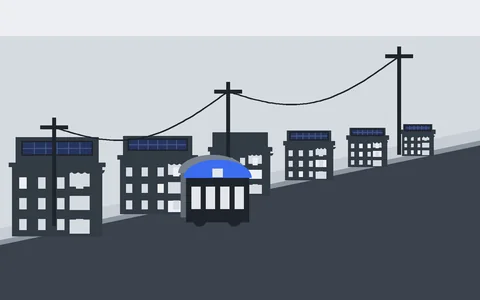
Every story about solar in this city has to answer for the fog. The marine layer parks over the western neighborhoods through many summer mornings, and rooftop panels out there start their day at a discount. The city's own generating history makes the point gently: its largest municipal solar installation, on the roof of the Sunset Reservoir in the fog belt, is on the order of five megawatts, completed around 2010, and it tripled the city's municipal solar capacity at the time. Five megawatts is a rounding error at the scale of 380,000 accounts. San Francisco did not meet its milestone by waiting for the fog to lift.
It met it the way community choice programs do: by buying renewable supply wherever it generates best, across California and the wider West, while the rooftops catch up. The rooftop work matters, and it is genuinely hard here; most of the housing stock predates electrification, and a bay window eats panel area the way the fog eats morning sun. But the accounting does not care where the electron was made. It cares what made it.
IV. The next ten years
The milestone that matters next is not a percentage; it is a load. As buildings electrify their heat and hot water, and as electric vehicles multiply, the city needs the grid to carry more, and to carry it in the evening, when solar is done for the day. The Mayor's Office has tied the program's success to the city's broader climate commitments, and the city's emissions have been reported well below their 1990 level, roughly 41 percent down at the 2021 announcement. The direction is right. The slope is the work.
Procurement, interconnection queues, storage, and the slow arithmetic of retrofitting a Victorian roof: these are unglamorous problems, and CleanPowerSF's first ten years suggest the city is at its best on exactly those. The program made a quiet promise in 2016. At last public report, it has kept it ahead of schedule.
V. How to read the claims
Everything above traces to public documents: the SFPUC's February 2025 announcement, the program's own site, CalCCA's materials, and the Mayor's Office 2021 climate announcement. Where figures can drift, we hedge them: "at last public report," "on the order of," "roughly." If a number in this story has moved, the program's own pages are the authority, and we want to know about the correction.
One clarification that often gets lost: renewable here is an accounting identity backed by certificates of procurement, not a claim that every electron in a San Francisco socket was made by a wind turbine at 7 p.m. in December. That is how every green tariff in the country works, and the program says so plainly if you read past the headline.
Frequently asked questions
What is CleanPowerSF?
CleanPowerSF is the community choice aggregation program run by the San Francisco Public Utilities Commission. The city buys electricity on behalf of residents and businesses, and it is delivered over the same wires and poles as before. The program began serving customers in 2016.
Do San Francisco customers have to sign up?
Historically, eligible residents and businesses were enrolled automatically when the program reached their neighborhood, with the option to opt out and return to the investor-owned utility's service. Enrollment terms can change, so the current rules are worth checking on the program's own site.
What is the SuperGreen option?
SuperGreen is the program's opt-up choice. On the program's current description it supplies 100 percent California-certified renewable electricity to customers who choose it, for a modest premium over the default Green service.
Does the fog stop solar power in San Francisco?
No, but it shapes it. The marine layer cuts output on the city's west side on many summer mornings, and districts that sit in the sun belt can generate through the same hours. Fog lowers production; it does not end it, and it is one reason the city pairs rooftop panels with purchased renewable supply.
Where do the figures in this article come from?
From public sources: the SFPUC's February 2025 announcement of the 2023 milestone, the CleanPowerSF program site, the California Community Choice Association, and the Mayor's Office 2021 climate announcement. Figures are stated as of those public reports and hedged where they may have moved.
References
- CleanPowerSF, program description and service options, cleanpowersf.org.
- San Francisco Public Utilities Commission, "CleanPowerSF Provides 100% Renewable Electricity to San Francisco Customers Two Years Early," February 5, 2025, sfpuc.gov.
- California Community Choice Association (CalCCA), member program profile and milestone coverage, cal-cca.org.
- Office of the Mayor, City and County of San Francisco, climate commitments announcement, April 22, 2021, sfmayor.org.
- San Francisco Chronicle, coverage of the city's accelerated climate targets, April 22, 2021, sfchronicle.com.
Filed by the Clean Energy SF desk. Figures are current as of publication and hedged where they move; the program's own pages are the authority. To request a correction, use the tip line linked from the footer of the front page.